How to Split Travel Expenses on Group Trips (Stress-Free Guide)
Splitting travel expenses in a group without creating tension is possible. Discover the 3 best methods and tools so everyone goes home happy — with no forgotten debts.
There's an unwritten rule on group trips: don't talk about money. And that's exactly why things go wrong.
Someone covers dinner, someone else forgets to pay back, a third person thinks they've already settled up… At the end of the trip, the memories are great but the accounts are fuzzy. That fuzziness, even when unintentional, creates tension that can sour a trip that was actually a success.
Good news: managing group expenses isn't complicated. You just need to pick the right method before you leave — and the right tools to apply it.
Why money creates tension on group trips
Money is a sensitive topic in general. On a group trip, three situations make it especially explosive.
Unreimbursed advances. Someone pays the hotel for everyone, someone else covers entry tickets, a third person picks up dinner. At the end, everyone feels like they paid a lot — and nobody has a clear picture of reality.
Unequal spending. Some people order the full menu, others stick to one dish. Some want the premium excursion, others prefer the beach. Splitting every bill equally ends up frustrating those who spent less.
The end-of-trip reckoning. When you try to recap everything on the last night, between fatigue, fuzzy memories, and lost receipts, the math becomes a real headache. Even with good intentions, mistakes happen.
These tensions don't come from a lack of trust between friends. They come from a lack of structure. And that can be fixed before you leave.
3 methods to split travel expenses
Method 1 — The shared pot
How it works: each group member contributes a fixed amount to a shared fund (physical or digital) before the trip. All shared expenses are paid from that pot. At the end, the remaining balance is redistributed equally.
Pros:
- Very easy to manage day to day — no need to wonder who pays for what
- Eliminates individual advances and later reimbursements
- Ideal for groups where everyone has a similar budget
Cons:
- Requires a correct upfront estimate of the shared budget
- Less flexible when group members have very different spending habits
- Needs a trusted manager to centralize the money
Best for: close-knit groups with similar spending habits, on a short trip (weekend, 4–5 days).
Method 2 — Everyone pays, settle up at the end
How it works: each shared expense is logged as you go, noting who paid and who was involved. At the end of the trip, a global calculation determines everyone's balance and the transfers to make.
Pros:
- Very flexible: each expense can be split differently
- No one needs to manage a shared pot
- Accurate and transparent if well documented
Cons:
- Requires logging every expense in real time — otherwise you forget
- Final calculation can be complex without the right tool
- Creates anxiety for some ("how much do I owe?" throughout the trip)
Best for: larger groups, longer trips, or groups with mixed budgets and habits.
Method 3 — The hybrid system
How it works: a shared pot covers large predictable fixed costs (accommodation, car rental, some pre-booked activities). Variable daily expenses (restaurants, cafés, small activities) are handled with settle-up-at-the-end.
Pros:
- Reduces the number of transactions to track
- Secures big expenses without blocking day-to-day flexibility
- Good balance for most groups
Cons:
- Slightly more complex to explain to the group
- Still requires tracking smaller expenses
Best for: most trips of 5 days or more, with a group of 4 or more people.
Real example: a weekend for 4 people, 12 expenses
To make this concrete, here's a simulation of a weekend in Barcelona with four friends: Alice, Bruno, Clara, and David.
| # | Expense | Amount | Paid by | For |
|---|---|---|---|---|
| 1 | Hotel (2 nights) | €320 | Alice | Everyone (4) |
| 2 | Outbound train | €160 | Bruno | Everyone (4) |
| 3 | Friday dinner | €92 | Clara | Everyone (4) |
| 4 | Picasso Museum | €60 | David | Everyone (4) |
| 5 | Saturday brunch | €48 | Alice | Alice, Bruno, Clara |
| 6 | Bike rental | €40 | Bruno | Bruno, Clara, David |
| 7 | Tapas lunch | €56 | Clara | Everyone (4) |
| 8 | Montjuïc excursion | €36 | David | David, Alice |
| 9 | Saturday dinner | €108 | Alice | Everyone (4) |
| 10 | Group souvenir | €30 | Bruno | Everyone (4) |
| 11 | Return train | €160 | Clara | Everyone (4) |
| 12 | Sunday coffee | €16 | David | Everyone (4) |
Total shared expenses: €1,126
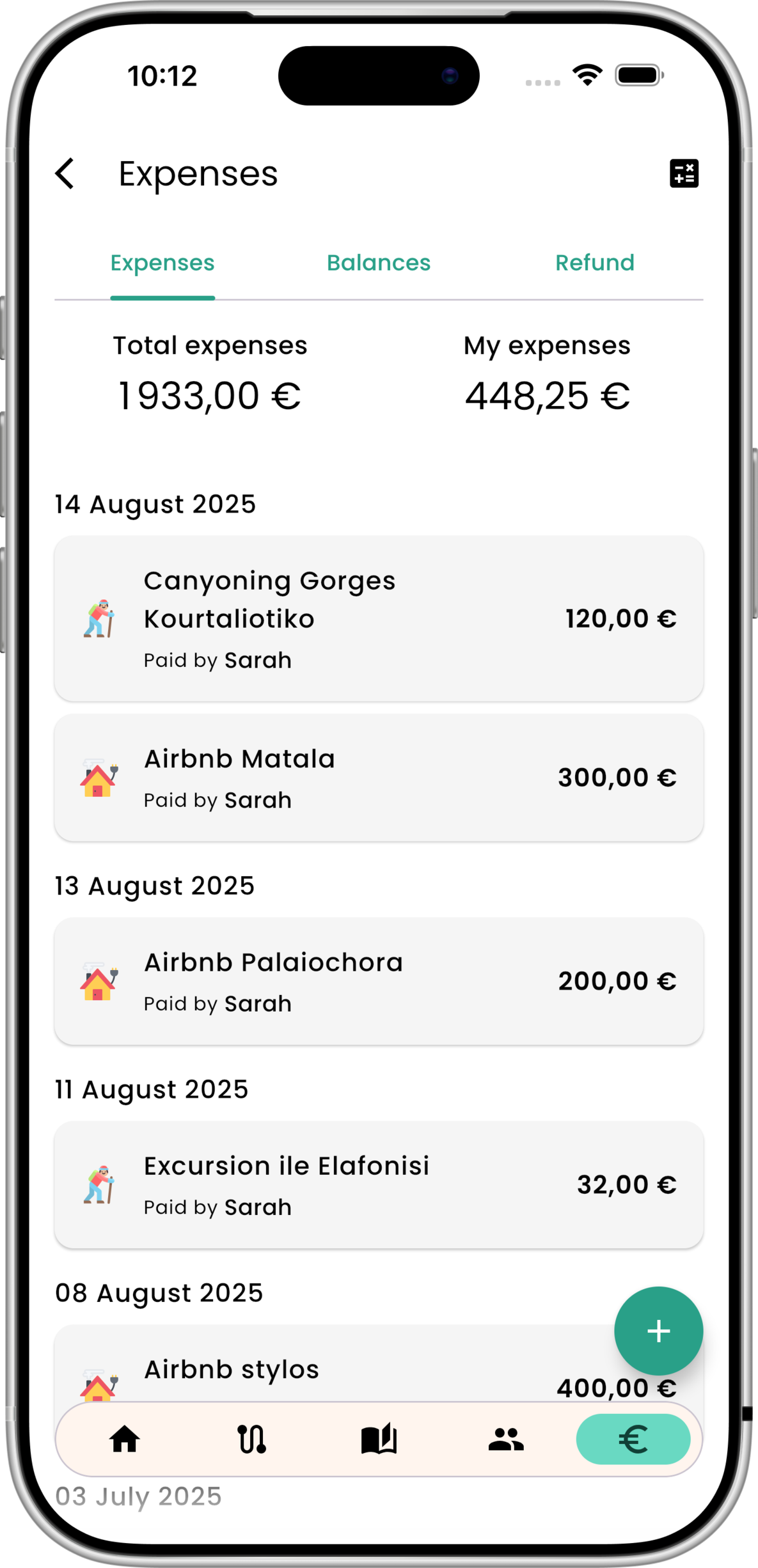
Without a tool, manually calculating who owes whom easily takes 20 to 30 minutes — and mistakes are common. With an app like Palmier, the calculation is instant and automatic. Each expense is logged when it happens, and the app shows everyone's balance in real time.
In this example, Palmier would automatically calculate that Bruno owes Alice €47, David owes Clara €23, and so on — without anyone pulling out a calculator.
Using an app to simplify expense management
Managing 12, 20, or 30 expenses by hand on a shared Excel spreadsheet is doable. It's just unnecessarily painful in 2026.
Dedicated apps like Palmier let you:
- Log each expense in seconds — amount, payer, people involved
- Calculate balances automatically — who owes whom, with exact amounts
- Track expenses in real time — the whole group sees account status at any moment
- Separate personal and shared expenses — handy so nothing gets mixed up
- Access accounts offline — useful abroad with a limited data plan
Unlike tools like Splitwise that only handle money, Palmier also includes itinerary, group chat, and travel journal — all in one place, without juggling multiple apps.
Rules to set before you leave
The right tool isn't enough if the ground rules aren't clear. Here are five points to align with the group before departure.
1. Who logs expenses? Either everyone logs their own payments (ideal for sharing the workload), or one person centralizes (simpler but creates dependency). Decide upfront and stick to it.
2. How are restaurant bills split? Equal shares? Everyone pays for what they ordered? Equal shares only on shared dishes? There's no single right answer — only the one your group chooses together.
3. What about optional expenses? If someone does an activity others didn't choose, it's clearly on them. But if an expense is suggested on the fly and some decline at the last minute, how do you handle it? Set the rule before it happens.
4. When do you settle up? During the trip (practical but can create friction) or at the end (cleaner but requires discipline in logging)? With an app that calculates everything automatically, both options work equally well.
5. How will reimbursements be made? Bank transfer, Venmo, PayPal, cash? Make sure everyone can be reimbursed through the same channel to avoid "I sent a transfer but I don't have your details."
Conclusion
Splitting travel expenses should never be a source of tension. With a clear method chosen before you leave and a tool that logs and calculates balances automatically, you eliminate almost all money-related friction points.
The golden rule: talk about money openly before you leave, rather than avoiding the subject and regretting it when you get home.
Palmier lets you manage shared expenses right inside your travel app, alongside itinerary, group chat, and travel journal. Everything is centralized, transparent, and the final calculation takes one tap.