How to Create a Shared Travel Journal with Friends: Why and How
A collaborative travel journal is the best way to keep memories alive after a group trip. Learn why it matters and how to set it up easily.
There's a strange thing that happens after every trip: memories fade much faster than you'd think.
The first few weeks, everything still feels fresh. You retell stories, laugh about mishaps, scroll through photos again. Then months pass, life resumes, and what felt etched in memory turns fuzzy. Place names slip away, details blur, and emotions lose their edge.
That's where a travel journal really shines — especially when it's shared among everyone in the group. A group trip means several perspectives on the same moments. You might as well capture them all.
Why travel memories fade so quickly
Memory doesn't work like a camera. It doesn't store events exactly as they happened — it rebuilds them every time you recall them, colored by your mood in the moment, what you've lived since, and what others have told you about it.
Research in cognitive psychology shows that episodic memory — the kind that holds personal experiences — is especially vulnerable to forgetting in the weeks after an event. Concrete details (names, places, dates, small anecdotes) are the first to go.
That's not a flaw. It's simply how the human brain manages information: it keeps the emotional core and clears the rest to make room.
The problem is that those "erasable" details are often what bring memories to life. "We were at this little wooden bar on the square at 11 p.m. when it suddenly started pouring" — that's the kind of detail you forget, and wish you hadn't.
A travel journal written while things are happening captures exactly what memory is about to lose.
Paper journal vs app: what actually works?
The charm of a paper journal
A paper journal has something irreplaceable. Handwriting slows you down, forces you to choose your words, and creates a physical connection to the memory. Many travelers stay attached to it for that reason.
But it has obvious limits on a group trip:
- It's individual. Each person keeps their own notebook, and perspectives never meet. You come home with five journals telling five versions of the same trip — and nobody will ever read the other four.
- It doesn't integrate photos. Pasting pictures into a notebook takes time and means printing them.
- It can be lost or damaged. A soaked notebook in a travel bag or one left in a hotel room happens.
The app: handy, but not always built for this
Photo galleries, Instagram, shared Google Photos albums — these are often the default. They're free and easy. But they're not designed to document a trip in a structured way: no day-by-day timeline, no space for narrative, no link to the itinerary.
The real value of a dedicated travel journal app is bringing story, photos, and trip context (place, day, itinerary step) together in one place — and letting the whole group contribute.
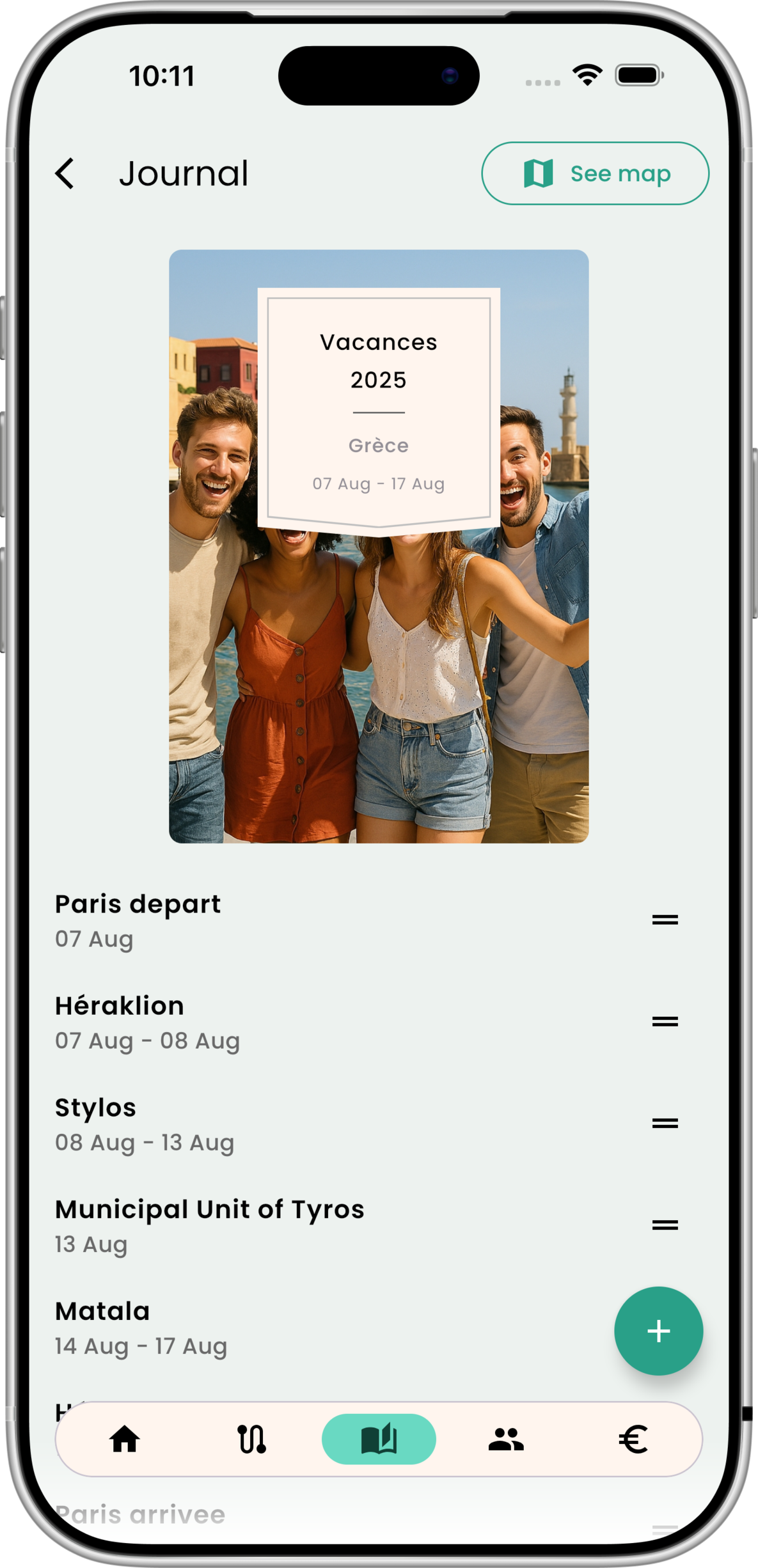
That's exactly what Palmier's journal feature offers: each member can add their own entries, photos, and anecdotes, and the result is a collective account of the trip, accessible to everyone, for good.
How to build a shared journal the whole group actually uses
Step 1 — Decide together to use a shared journal
It sounds obvious, but it's a real group decision. If some members don't see themselves writing anything on vacation, it's better to know before you count on their contributions.
The good news: a shared journal doesn't require everyone to write. Some contribute text, others photos, others short notes or pinned places. There's no required format — everyone participates their own way.
Step 2 — Pick your tool before you leave
Don't leave it to chance. Create the journal (or the trip in the app) before departure, invite every group member, and do a quick test so everyone knows how to add an entry. Two minutes of onboarding upfront beats "I don't know how this works" mid-trip.
With Palmier, the journal is built into the trip — no separate app needed. The whole group accesses the same space from Android or iOS.
Step 3 — Feed the journal during the trip, not after
This is the most important tip. A travel journal filled in after you're home doesn't have the same flavor as one written in the moment.
Make a habit of adding a short entry at night before bed. No need for long text — three sentences about the day, a photo or two, and one memorable anecdote are plenty. It's quick, and it's exactly what you'll be glad you wrote two years later.
Step 4 — Let everyone contribute their own way
In a group of five, you might have one person writing long descriptive paragraphs, two posting mostly photos, one noting practical details ("that restaurant is called X, address Y, must remember"), and one who barely contributes but loves reading everyone else's posts.
All of that is valid. A good group travel journal isn't uniform — it's a patchwork of different perspectives, and that's what makes it valuable.
Ideas for what to document on the road
Not sure what to write? Here's a list to keep inspiration flowing:
Everyday moments
- The typical breakfast in the country, with what was on the plate
- The bus or train ride between cities — landscapes, conversations
- The hotel room at first sight (pleasant surprise or not)
Unexpected discoveries
- A local market you stumbled on
- An unplanned restaurant recommended by a passerby
- A street, neighborhood, or view that wasn't on the itinerary
Group stories
- The day's mishap (missed metro, confusing order, wrong turn)
- The quote of the day — the one that made everyone laugh
- The "we'll remember this" moment — even (especially) if it was uncomfortable at the time
Sensory details
- The smell of the spice market
- The heat at 2 p.m. in the alleys
- The background noise of a busy terrace
Practical recommendations
- Addresses to remember (and ones to skip)
- Tips discovered on the ground (combo ticket, best time to visit, little-known bus stop)
Those practical notes especially do double duty: they enrich the memory and help if someone else in the group — or a friend you recommend the destination to — wants to repeat the same trip.
Keeping memories accessible after the trip
A travel journal only matters if it stays accessible. Here's how to make sure it doesn't vanish into an inbox or a forgotten hard drive.
Centralize in a lasting app. Apps like Palmier keep the trip and journal after the vacation ends. No expiry date, no automatic deletion — the journal stays available as long as you want.
Make a physical backup if you like. Some people print favorite photos and texts for a photo book. Services like Shutterfly or local print shops make it easy from your phone. It's optional, but a nice post-trip project to do together.
Share highlights with your circle. A group travel journal is also natural content for Instagram, a blog, or friends who weren't on the trip. Multiple perspectives make it far more interesting than a solo photo album.
Conclusion
A shared travel journal is a gift you give your future self. In five years, when you open those notes and photos again, you'll find not just images — but the words, emotions, and details that bring the memory back to life.
And unlike a memory in your head, that one doesn't fade.
Palmier builds a collaborative travel journal right into your trip planning app. Every group member can add photos, text, and anecdotes — on the road, from their phone, in seconds. Everything stays alongside your itinerary, group chat, and shared expenses.
Because a great trip deserves to be told by everyone who lived it.