Solo Travel: The Complete Guide to Leaving Organized and at Ease
Plan a solo trip without stress: destination, budget, itinerary, safety, and tools. A practical guide to making the most of traveling on your own.
Traveling alone is neither a punishment nor a performance — it's often a deliberate choice: fewer compromises on timing, more openness to meeting people, and that rare feeling of deciding for yourself. What scares people isn't solitude itself: it's total improvisation. Landing with no lodging booked, no sense of the real budget, no plan for how you'll remember the trip once you're home.
The good news: organizing a solo trip doesn't mean locking yourself into a military schedule. It means setting a light structure — solid enough to sleep well, flexible enough to say yes to a hike suggested by travelers at the hostel.
Why solo travel changes the game (and who it's for)
Solo travel appeals to more and more young professionals and thirty-somethings: occasional remote work abroad, wanting to reset after a big year at work, or simply enjoying not negotiating every museum visit with five different opinions.
Concrete advantages: you move at your own pace, you talk more easily to locals and other travelers, and you learn to trust yourself when something goes wrong. Many come back with different energy — not because they "found themselves," but because they made decisions alone for ten days straight.
Who it's for: if you value autonomy, you can handle eating alone sometimes, and you accept that some evenings will be quiet. If you need constant group validation to have fun, maybe start with a test weekend before a month in Asia.
And if you travel with others later? Skills built solo — budget, itinerary, communication — also help when you plan a group trip with friends.
Choosing your destination and length (without getting it wrong)
Your first solo trip isn't the moment to pick a country where every move is a logistics project. Favor a destination with clear tourist infrastructure, a language you understand at least a little (or widely spoken English), and a reasonable safety reputation for travelers.
First solo: a weekend in a European city or five days in Portugal often beats three weeks in an exotic destination. You test your organization, your evenings alone, your ability to handle surprises — without committing to a huge budget.
Duration: allow half a day of "floating" at the start (travel fatigue, finding your bearings) and one at the end (recovery before the return). In between, one active week plus a few calmer days works well.
Three simple criteria before you commit:
- Time budget: how many days can you be away without financial stress when you get back?
- Language comfort: arriving unable to order coffee gets tiring fast when you're solo.
- What you want now: city and culture, nature and hiking, or a mix — one direction avoids scattering your trip.
Think about season too: extreme heat or monsoon rains feel very different when no one is there to share the experience with you.
Solo travel budget: how much to plan and how to track it
Solo, you pay for lodging and sometimes taxis alone — but you also choose your meals without negotiating. A realistic solo travel budget rests on five lines: transport (flights/trains), lodging, food, activities, and a 10–15% contingency margin.
| Category | Europe (7 days) | Southeast Asia (7 days) |
|---|---|---|
| Lodging | $380–750 | $160–380 |
| Meals | $220–380 | $85–160 |
| Local transport | $85–160 | $45–85 |
| Activities | $110–270 | $65–130 |
| Total excl. flights | $795–1,560 | $355–755 |
These ranges are indicative: trendy city vs hostel, restaurant vs street food. What matters is tracking spending as you go — a notes app, a spreadsheet, or, if you share a leg with other travelers (shared room, group tour), a tool to split travel expenses.
Solo tip: book your first two nights in advance to land calmly; keep the rest more flexible to follow your mood.
Building a flexible itinerary (not a military plan)
Solo trip planning works well with the 80/20 rule: 80% of activities or places you really want to see, 20% open slots to wander, read, or accept an invitation.
One base per area: avoid changing hotels every night. You lose time on checkout/check-in and tire yourself carrying your bag. Three nights in one place, then move — often the best solo compromise.
Realistic transit time: maps apps can be optimistic; add buffer for local buses, crowds, coffee stops. Solo, no one pushes you to "fit in one more thing" — that's a strength, as long as you don't overload yourself.
Tip: solo travelers tire faster from deciding. Cap yourself at two or three structured choices per day (museum in the morning, free afternoon in a neighborhood). Let the rest emerge.
A day-by-day itinerary in an app like Palmier gives you a thread you can adjust on the road — without feeling locked in.
Safety, solitude, and well-being on the road
"Is solo travel dangerous?" comes up often. The honest answer: it depends on place, time of day, and preparation — not on being alone in itself.
Practical safety:
- Digital copies of documents (passport, insurance) in the cloud plus a paper copy separate from your main bag.
- Share your approximate itinerary with someone you trust and a daily or weekly check-in ("I'll message when I have Wi-Fi").
- Avoid arriving in an unknown city in the middle of the night with no reservation.
- Trust your gut on routes and people — without sliding into paranoia.
Solitude vs boredom: solitude is quiet evenings; boredom is when the day has neither structure nor connection. A light itinerary and an open approach (cafés, hostels, short tours) usually balance both.
When to slow down: if you're stacking exhausting days, plan a half day off. If something feels wrong, change neighborhood or lodging — solo, you can without a group vote.
Essential tools for solo travelers
A few apps genuinely structure daily life:
- Offline maps (Maps.me, downloaded Google Maps) so you're not dependent on signal.
- Translation for quick exchanges.
- Booking (lodging, tickets) with confirmations in one place.
- Travel journal to capture what memory will erase quickly.
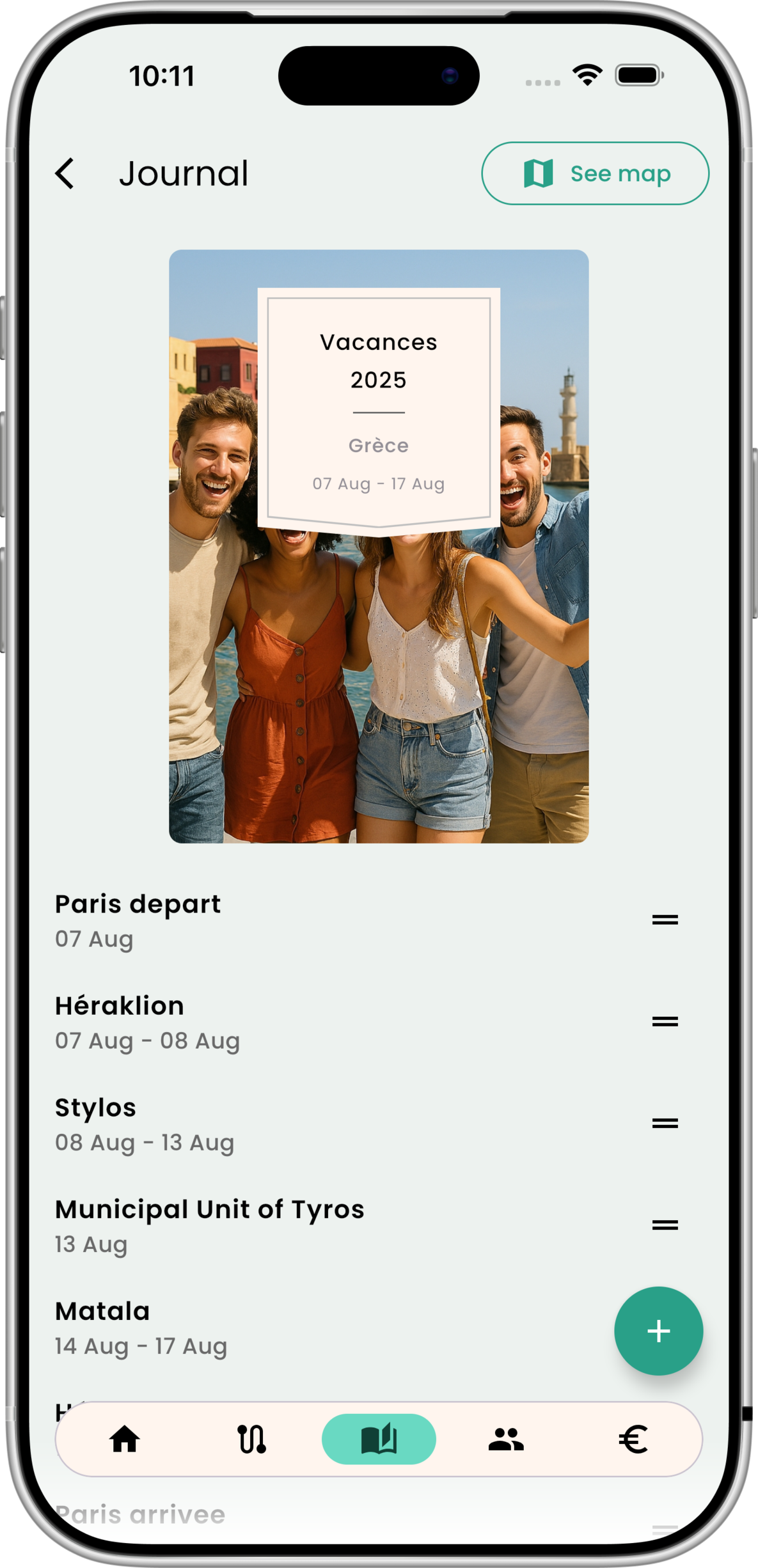
Palmier is built mainly for group trips, but it fits solo travel well: a clear itinerary and a personal journal with photos and notes. If you team up with other travelers for a week, the same space switches to chat and shared expense tracking — without changing tools.
To compare Palmier with TripIt, Splitwise, or Wanderlog, see our article on the best group travel apps in 2026 — most criteria still apply when you're traveling alone.
Keeping memories alive (even solo)
Photos alone aren't enough: in six months you'll recognize the cathedral but not the market anecdote or the guide's name.
During the trip: three sentences at night, one photo that matters, one sensory detail (smell, sound, weather). Five minutes — not a novel.
A shared travel journal isn't only for groups: start as a personal journal; if you bond with people on the road, invite them to contribute toward the end of the trip.
After you return: reread your notes before they fade. You'll see whether the next trip — solo or with friends — is already taking shape.
Conclusion
A successful solo trip isn't one where everything is perfect: it's one where you have enough structure to relax and enough freedom to say yes to the unexpected detour.
Plan your itinerary and travel journal with Palmier — free on iOS and Android. Start with a short test trip: a weekend, one city, a tracked budget. If it clicks, the world is wide — and you don't need anyone else to enjoy it, only a bit of organization.
Palmier — itinerary, journal, and group tools when you need them.